 As with his play The School of Night, Peter Whelan similarly makes a compelling character narrative from the dramatic extrapolation of some known historical facts about the periphery of William Shakespeare’s life in The Herbal Bed.
Susanna Hall is a strong, intelligent woman, married to John Hall, a successful doctor in Stratford. She cares a great deal for John, yet for whatever reason their sex life has withered on the vine. And while Susanna is deeply concerned for maintaining her husband’s respectability, she aches for some physical intimacy. When an attraction grows between her and artisan Rafe Smith, one fateful night they are almost caught in the act by her husband’s recently dismissed apprentice, wastrel Jack Lane. When Lane then spreads vengeful gossip, Susanna, John and Rafe resolve to take him to ecclesiastical court for slander, a slander which they all know to be only partly untrue.
This fascinating play is a tight character drama with a simple yet captivating plot that deals with basic human foibles in a time of rising social and religious conservatism from the puritan reformists during the reign of King James I. In this climate protecting one’s public reputation becomes a matter of dire consequence. Although far more concentrated and less broad in ramifications, the play has definite thematic similarities to The Crucible, with a strong undercurrent of paranoia. The similarity to Miller’s play becomes all the more pronounced with a courtroom scene towards the end, and one moment in particular seems almost inconceivable to have not been directly referencing the modern classic, for the purpose of a rather nice little subversion of one’s resulting expectations.
Susanna is an intriguing woman for her post-Elizabethan historical context, depicted as free-thinking and independent, and yet mindful of her place in society, gaining knowledge from her husband’s healing science and rendering him assistance in the preparation of medicines, yet being careful not be seen doing so by the public. She also happens to be the daughter of a certain W. Shakespeare, but this is almost by-the-by.
Or is it? Susanna’s aging, ailing father never appears onstage, being barely mentioned for much of the play (aside from a small plot twist), and yet it seems likely that Whelan’s characterisation of the former Susanna Shakespeare as a feisty, forthright yet ultimately moral woman is indeed informed by a link to her famed father and his perceived humanism. Indeed, it would not be the greatest stretch to imagine that Whelan sought to imbue Susanna with echoes of the Bard’s characters such as Viola, Beatrice or Rosalind, if not directly, then perhaps at least in spirit. Whether by this he means to suggest that his depiction of Susanna was herself influenced by her father’s work or merely inherited his vigour along with his keen mind is an interesting thought.
Having missed the 1997 STC production of The Herbal Bed, I had no preconception of how this play might be staged, but this excellent, highly focused production was easily as good as anything I could have hoped for. With a uniformly fine cast and some excellent, inventive direction by Sarah Giles (who similarly impressed with her graduating piece at NIDA late last year), the calibre of this production would not seem out of place at Belvoir Street or Wharf 1.
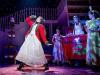
Giles’ deceptively simple direction contains many stylised touches that frame the action in ways one imagines are not scripted, yet never seem contrived or out of place. On the contrary, they considerably enhance the play through simple touches such as reinforcing its theme of the power of words through strewn fragments of torn manuscript and whispered snippets of dialogue.
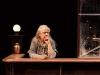
One of the nicest touches was performing all the action in a confined portion of the New’s relatively large stage, demarked by painted-on boundaries which characters cross as though passing through unseen doors, while those not currently appearing in the scene remain onstage, outside this border. While this is in and of itself an old technique of theatrical alienation, Giles works it to quite different effect, directing her actors to sit down and maintain intense eye contact with those performing the current scene in the “active” centre of the stage. This adds a subtle yet chilling reinforcement of the play’s atmosphere of paranoia and mistrust, that these characters exist in a small bubble which the suspicious community is always seeking to peek inside.
The cast is particularly strong, one and all. Gemma Yates-Round is highly credible as the endearing, put-upon servant Hester, David McLaughlin shifts between delightfully supercilious and suitably menacing as the self-righteous Rev. Goche, while Dave Kirkham does a nice turn in investing a smooth politician’s air in his Bishop Parry.
Although one may be initially a little thrown by the rather camp foppishness of his performance, Rick Cosnett does very strong work in the role of conflicted antagonist Jack Lane, bringing a sense of pathos to this charming yet ultimately pathetic character, a self-indulgent brat with destructive impulses yet a seemingly genuine remorse for them. As a kind of yin to Lane’s yang we have Rafe Smith, Susanna’s would-be lover consumed by opposing tugs of desire and a puritanical fear of sin and judgment. Certainly the most conscience-stricken character, Jamie Irvine wonderfully conveys Rafe’s intense feelings of moral dread, especially when confronted with the possibility of lying under oath.
Perhaps the most interesting and nuanced performances of all are, unsurprisingly, those of the play’s leading roles. Keith Agius is superb as John Hall, playing up the character’s proud, puritan tendencies with a mildly humorous touch of quintessentially English reserve without ever tipping into comedy, skillfully balanced with the character’s suppressed darker undercurrents of rage and grief, creating a layered and compassionate character. Similarly, Fiona Pepper has a difficult task with managing the different facets of Susanna, a part that one suspects on paper may seem to elicit little sympathy or have the potential to come across as cold or even hypocritical. On the contrary, it is an intriguing and nuanced character who is neither whore nor saint, proto-feminist nor “good woman” of her times, but rather a character of considerable (if unconventional) integrity and complex motivations that may seem contradictory to others yet are underpinned by a clear moral conviction. Pepper successfully wrangles all these difficult elements and allows a potentially thankless role to blossom.
The Herbal Bed is a refined production of a deeply engrossing play, and a feather in the cap of all those involved.
new theatre presents
THE HERBAL BED
by Peter Whelan
Directed by Sarah Giles
Venue: new theatre | 542 King Street Newtown NSW
Dates: 19 March – 11 April 2009
Times: Thursday – Saturday 8pm , Sunday 5pm
Tickets: $28 full / $22 concession, groups 10+
$10 preview Wednesday 18 March 8pm
Pay What You Can (min $10) Sunday 22 March 5pm
Bookings: 1300 306 776 / www.mca-tix.com.au